
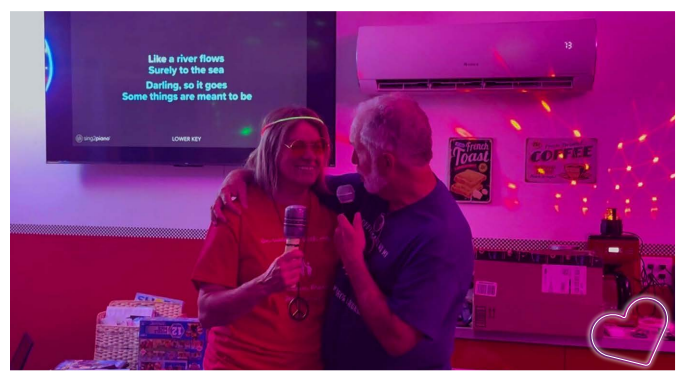
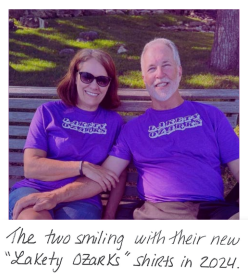
Last summer, we took a vacation I’ll never forget. Our favorite spot for this annual trip is Lake of the Ozarks (or as we referred to it as kids, “Lakety Ozarks”). The vacation home we stayed at this year was especially unique. Every room of the house was decorated for a different generation: ‘50s living room and ‘60s, ‘70s, ‘80s, and ‘90s bedrooms. As we walked through the door with stars in our eyes, we couldn’t wait to commence a weekend of good food, lots of laughs, and our first annual karaoke night!
The weekend festivities we chose all catered to one special person in our lives, my mom, who is living with late stage (and early onset) Alzheimer’s. If you’re familiar with the disease, you know that music is a wonderfully powerful memory cue which seemingly reawakens cognitive abilities, a true joy for each of us. We knew karaoke would be fun for all of us to enjoy. As we turned up the jukebox (‘50s living room . . . remember?), we put on rose-colored glasses, silly wigs, and passed out inflatable instruments. First up to the microphone was . . . my dad? I couldn’t wait to see what song he would choose to sing.
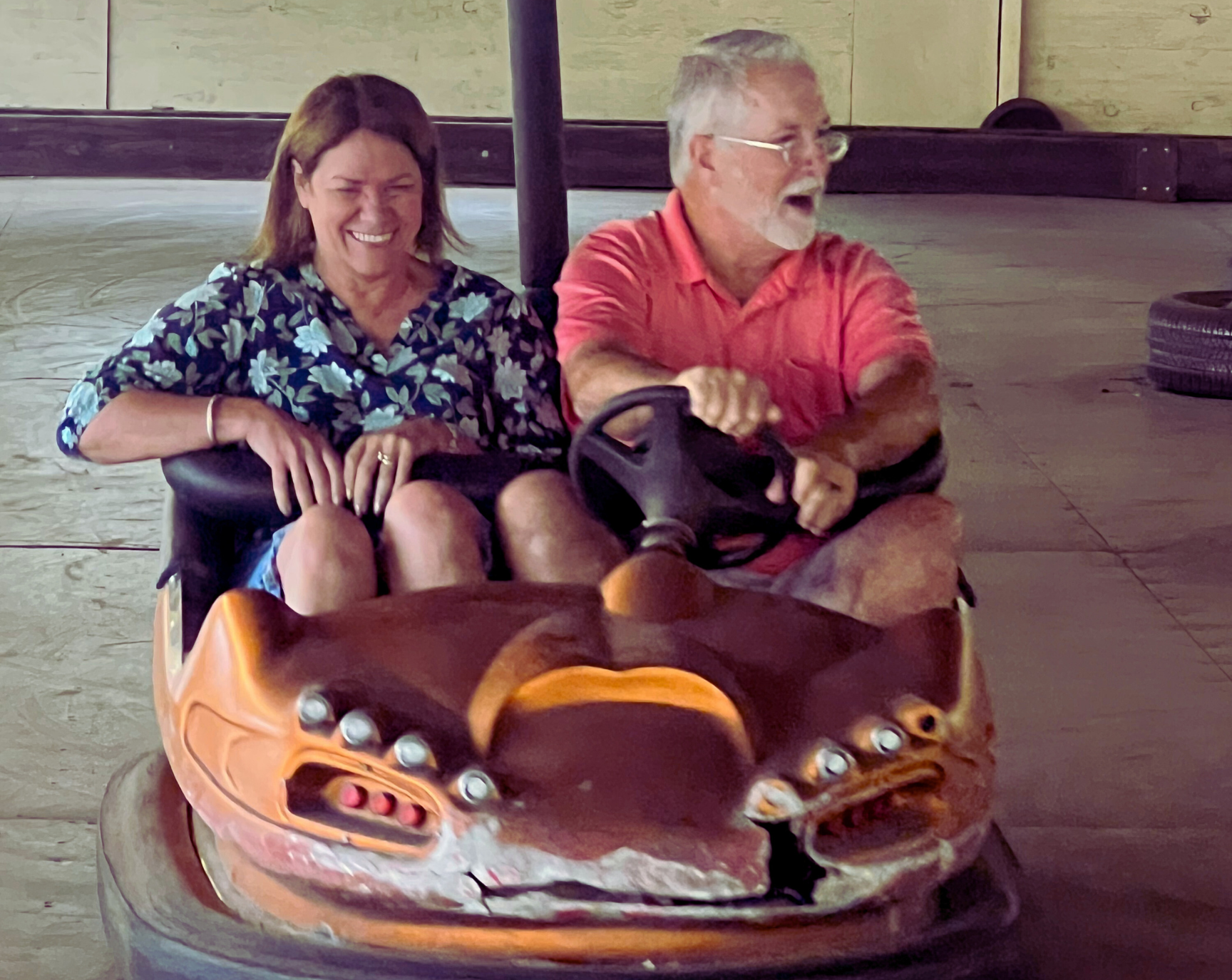
It was exciting to see him let loose. After all, once mom was diagnosed, he began taking on more and more. He did all the driving, he cooked all the meals, he cleaned the house, he handled Christmas preparations, he was responsible for everything. Doing so meant he had to forgo their social life, his career, and time alone. As the disease progressed, he eventually lost their marriage too—as mom could no longer converse or connect relationally. As most caregivers do, he neglected his own physical and emotional needs to attend to hers. He had let go of almost everything that made him happy so he could be her caregiver. What a man.
That night on vacation, as he pulled mom to the “stage” for karaoke and proceeded to sing “Can’t Help Falling in Love” by Elvis Presley, I saw it. I saw him look into her eyes and serenade her the same way he had when they were madly in love. I saw him gently take her hand to dance with her with as much intention as their wedding day 42 years earlier. I saw him not just as my dad, or a caretaker, but I saw him in a new light (that was quite unexpected given the setting of the evening): I saw him as a leader.
If there’s a name next to “busy body” in a dictionary, it’s Dad. The man can’t sit down, he can’t stay off committees, and he can’t keep tools out of his hands (blame it on being an only child). He has always been a leader, but the type of leadership I recognized in him that night was different. He wasn’t leading the church or his employees, he was leading his family. He was modeling for us what true masculinity looks like in a time of crisis. It meant not retreating, but leaning in, loving harder, and making sacrifices.
What I was witnessing in my own family is what Vitae’s research confirms, men inherently see themselves as providers and protectors. When men know their role is essential and the responsibility belongs to them, they step forward into their strength.
Before, when I thought of masculinity, I thought of lifting weights, being competitive, and overly assertive. But what I overlooked is that masculinity shows up in so many other ways. Like when men choose to protect their family from abortion or when they lay down their life as they know it to protect their loved ones. Why doesn’t our culture celebrate this kind of quiet male strength?
When men step into their roles as providers and protectors, they are impacting generations. As my sister and I observe my dad, so do my children, my extended family, my coworkers, those at church, and so many we’ve met along this journey.
In the moment, when my dad decided to become mom’s caretaker, it seemed so noble to me. But now that I’ve seen his endurance for almost eight years, it has been an incredible witness to me. His leadership has stabilized our family in a time of crisis. His sacrifices have allowed my mom to remain comfortable in her own home for so many years. And most of all, his love is obvious without ever having to say a word. That is masculinity.

By Kelsey Brown
Chief Communications
Officer